By Gourab Patra,
In the forested hills of southern Odisha, far from corporate boardrooms and policy summits, a quiet but enduring system of sustainability has been operating for centuries.
In the Koraput region, tribal communities such as the Paraja, Gadaba, Kondh, Saora, Bhumia, and Bondas mark their agricultural year with Deali Parab, a festival that is less about spectacle and more about systems. At its core, it is an annual audit of relationships between people, land, livestock, ancestors, and nature.
Known variously as Deali, Diali, Diyali, or Bihan Utara (literally, “seed pause”), the festival offers a compelling counterpoint to modern ideas of growth, productivity, and value.
A Pause Built Into the Economic Calendar
Unlike industrial agriculture, which prioritises continuous output, Deali Parab institutionalises rest.
In many villages, farming activity is deliberately paused. Seeds are symbolically “rested”. Fields lie untouched for a period. The break is not seen as lost time, but as an investment in long-term fertility and balance.
For business leaders accustomed to quarterly targets, this idea may seem counterintuitive. Yet the logic is sound: land, like people, performs better when cycles of effort are matched with cycles of recovery.
Agriculture as a Shared Asset, Not a Commodity
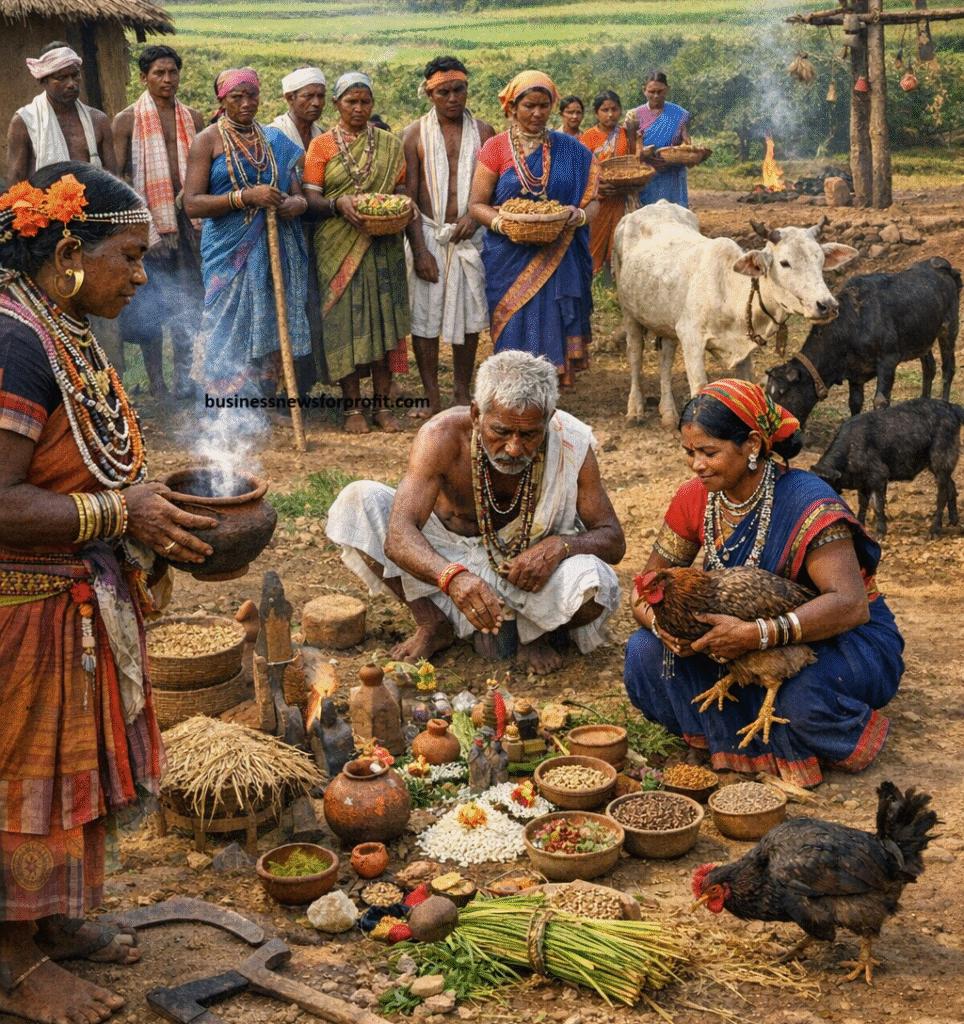
For Koraput’s tribal communities, farming is not an individual enterprise but a collective responsibility. Before the season’s first harvest is consumed, produce is offered to village deities and ancestors. Only then does the community eat.
This ritual does more than honour tradition. It enforces restraint, discourages hoarding, and reinforces a sense of shared ownership over natural resources.
Offerings typically include maize, millets, tubers, forest produce, and traditional rice beer. The message is clear: consumption follows accountability.
Livestock at the Centre of the Value Chain
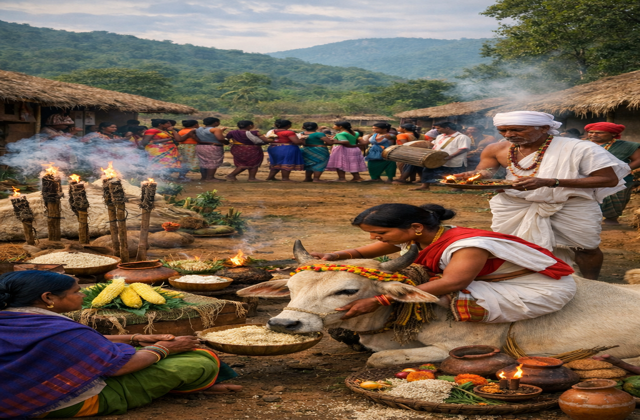
One of the most striking aspects of Deali Parab is its emphasis on cattle. Over three days, cows are bathed, decorated, fed ceremonial meals, and ritually honoured. Women play a central role in these practices, underscoring the gendered stewardship of both home and agriculture.
In modern economic terms, cattle are treated not as assets to be exploited, but as partners in production. Without healthy livestock, farming collapses. The festival makes that dependency visible and explicit.
The final day honours the cowherd, who moves from house to house singing and dancing, collecting grain contributions. Labour, in this system, is publicly recognised and ritually rewarded.
Ancestors as Stakeholders
At dusk during Deali Parab, families light jute torches and call their ancestors home in a ritual known as Bada Badua Daka. The symbolism is powerful: the dead are not gone, they remain stakeholders in the wellbeing of land, livestock, and family.
In corporate language, this is intergenerational governance. Decisions are made with past and future in mind, not just immediate returns.
Community Governance Without Contracts
Village priests guide the rituals, but decision-making is collective. Major choices, such as acquiring livestock for future ceremonies or addressing community concerns, are often timed around the festival.
There are no written bylaws, yet compliance is high. Participation is universal. Social hierarchies flatten. Work stops. Music, dance, and communal meals take over.
From a governance perspective, Deali Parab functions as a social reset, reinforcing trust, accountability, and cohesion.
Cultural Capital in Motion
As evening rituals give way to celebration, the village comes alive with drumbeats, flutes, folk songs, and the circular Dhemsa dance. Children learn stories. Elders pass on memory. Knowledge moves not through textbooks, but through participation.
In an era when organisations spend heavily on “culture building”, these communities demonstrate how culture endures when it is lived, not branded.
Why This Matters Beyond Koraput
As modernisation reaches tribal regions, some practices adapt. But the core values of Deali Parab remain intact: gratitude, restraint, reciprocity, and respect for ecological limits.
For policymakers, sustainability professionals, and business leaders, the festival offers a reminder that resilient systems are rarely extractive. They are relational.
Deali Parab is not nostalgia. It is a working model of long-term thinking, one where success is measured not by surplus alone, but by continuity.
A Different Definition of Prosperity
In Koraput, prosperity is not defined by how much is taken from the land, but by how well relationships are maintained, year after year.
At a time when economies worldwide are rethinking growth, climate responsibility, and stakeholder capitalism, this modest tribal festival makes a quiet but persuasive case:
Progress does not always require acceleration. Sometimes, it begins with a pause.
No Responses