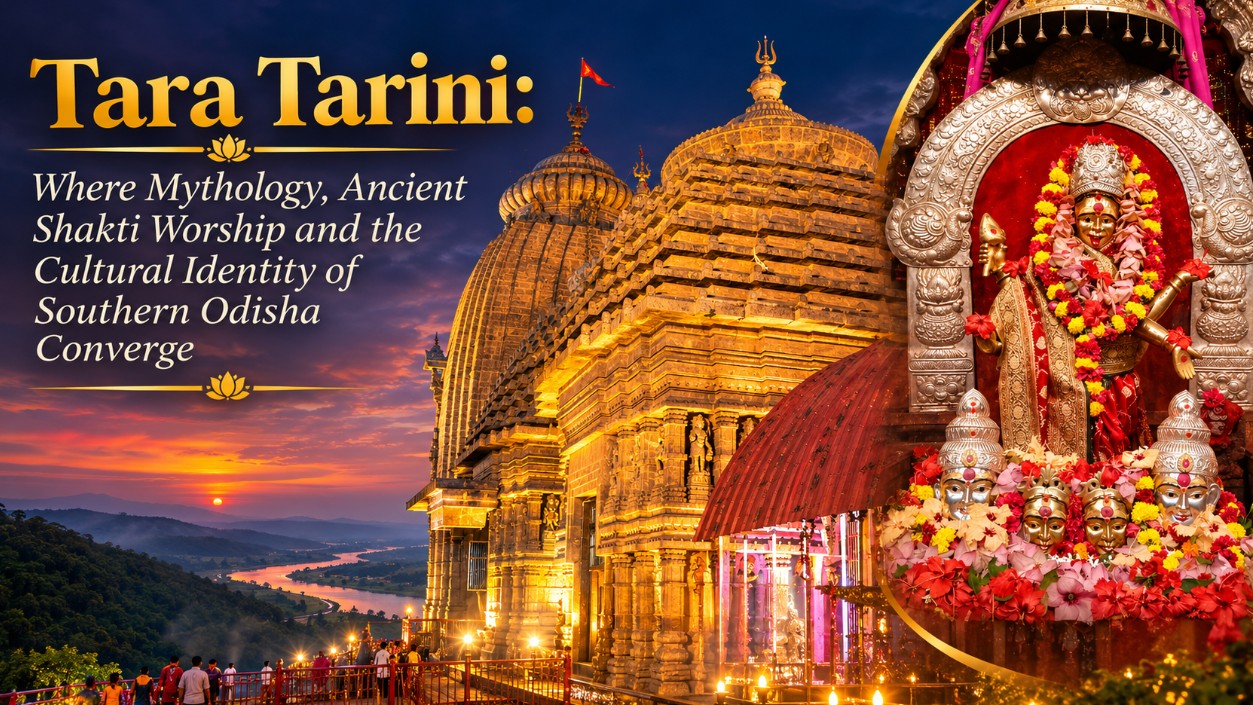
Perched atop the Kumari Hills, overlooking the winding course of the Rushikulya River in Purushottampur, Odisha's Ganjam district, the Tara Tarini Temple represents far more than an important destination of Hindu pilgrimage. It is a sacred landscape where mythology, historical memory, indigenous spiritual traditions and regional cultural identity intersect. Revered as one of the major Adi Shakti Peethas, the shrine is traditionally believed to mark the place where the breasts of Goddess Sati fell, establishing its association with divine motherhood, nourishment, fertility and the sustaining power of feminine energy.
Yet the significance of Tara Tarini cannot be understood through mythology alone. Its deeper cultural meaning emerges from the relationship between the twin goddesses, the geographical setting of the shrine, the evolution of Shakta worship and the collective rituals through which generations of devotees have sustained its religious importance. The temple offers an illuminating perspective on how sacred traditions evolve while retaining their essential spiritual character.
The Mythology of Divine Motherhood: Beyond the Legend of Sati
The foundation of Tara Tarini's religious identity lies in the Shakta tradition, in which the Divine Mother is understood as the supreme cosmic power responsible for creation, preservation and transformation.
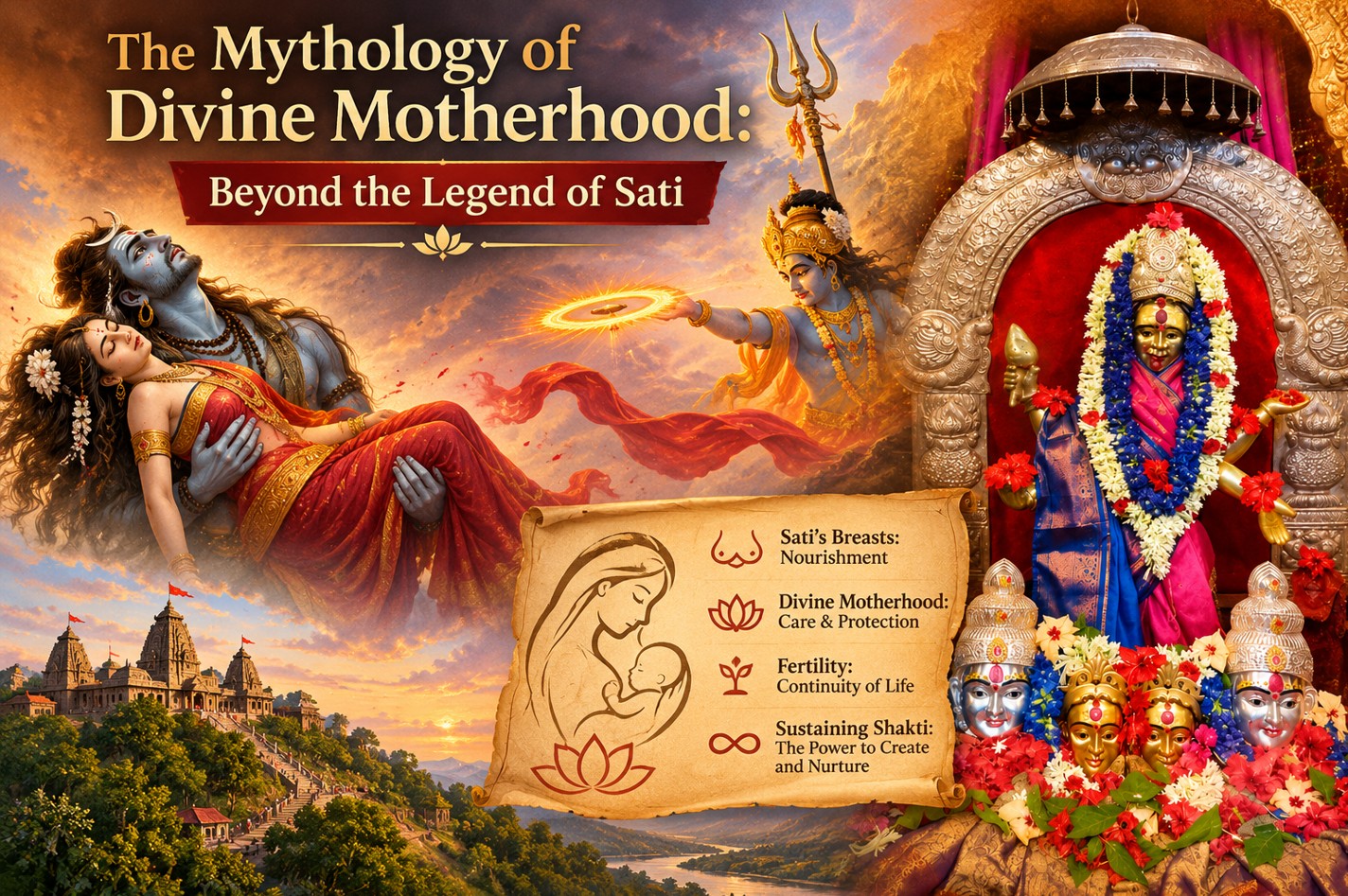
According to the widely revered narrative of the Shakti Peethas, following the death of Goddess Sati, Lord Shiva carried her body in profound grief. To restore cosmic balance, Lord Vishnu used his Sudarshana Chakra to divide the body, and the places where its different parts fell became sacred centres of Shakti worship. Tara Tarini is traditionally identified as the site where Sati's breasts fell.
Representational Image
This association carries considerable symbolic significance. In religious imagination, the breasts represent nourishment, maternity, protection and the capacity to sustain life. Consequently, the shrine's mythology extends beyond the commemoration of a divine event. It expresses a larger philosophical understanding of feminine power as the source of existence and the sustaining force behind the universe.
The names Tara and Tarini also offer an important interpretative dimension. Tara is widely associated with deliverance, guidance and the power to help devotees cross the ocean of worldly suffering. Tarini similarly conveys the idea of one who carries or rescues devotees through difficulties. Together, the twin deities embody a vision of divine protection that combines maternal compassion with spiritual liberation.
The Twin Goddesses: A Distinctive Expression of Shakti
One of the most distinctive characteristics of Tara Tarini is the worship of two closely associated manifestations of the Divine Mother.
The twin form invites an interpretation of Shakti as a dynamic and complementary cosmic principle. Rather than presenting divine power through a single visual identity, the shrine expresses it through two interconnected forms, symbolically suggesting multiplicity within unity.
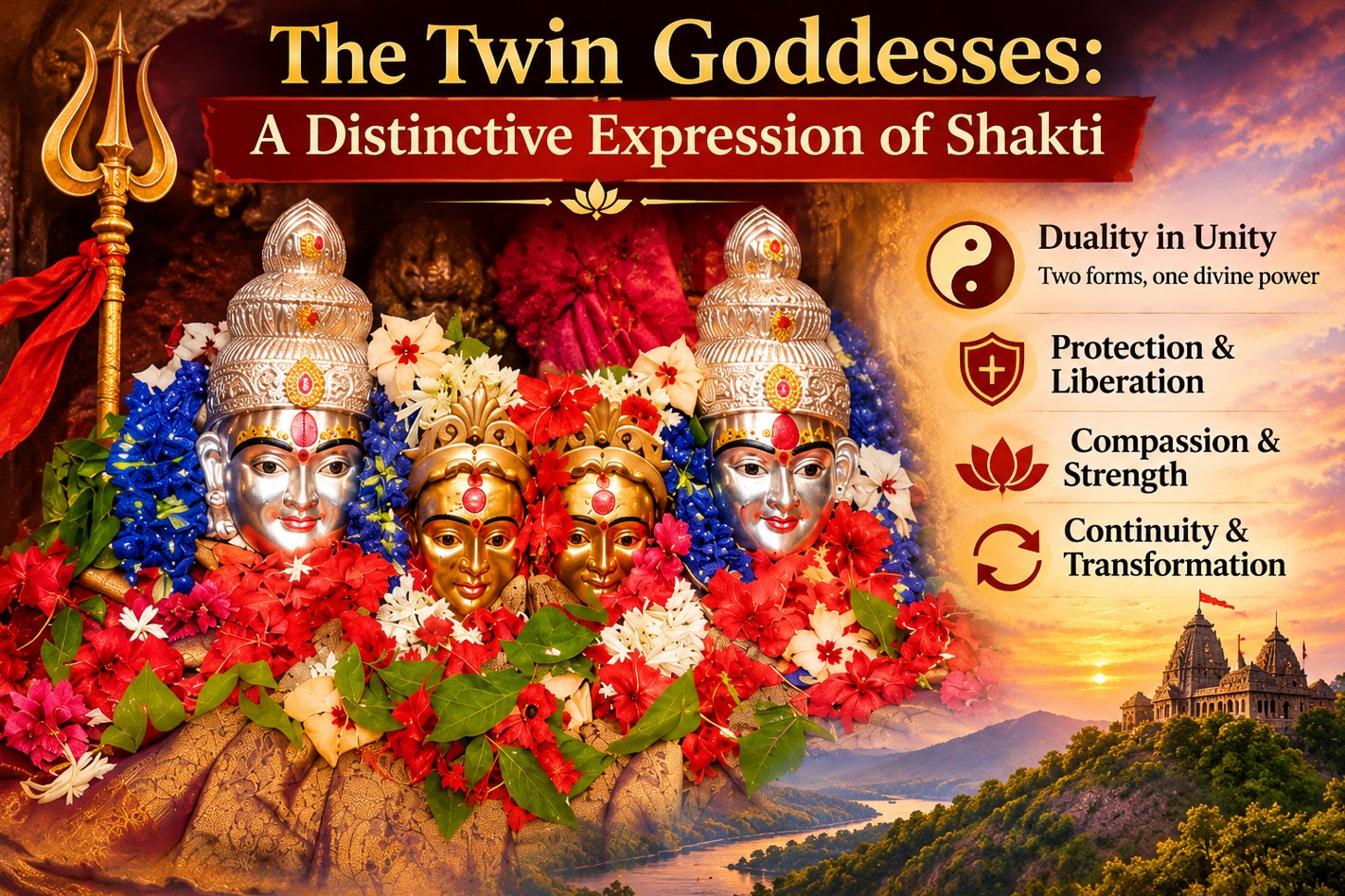
This duality can be understood through several dimensions of religious experience: protection and liberation, compassion and strength, continuity and transformation. Although these interpretations should not be confused with a single established theological doctrine, they provide a meaningful framework for understanding the distinctive appeal of the temple.
The twin goddesses also occupy a special place in the religious consciousness of southern Odisha. Their presence is not confined to scriptural narratives or temple rituals; it is embedded in family traditions, vows, festivals and everyday expressions of devotion. The shrine therefore functions as both a theological centre and a living repository of regional religious memory.
Ancient Sacred Geography: The Hill, the River and the Feminine Divine
The geographical setting of Tara Tarini is central to its religious character.
The temple stands on the Kumari Hills, overlooking the Rushikulya River. The relationship between an elevated sacred site and a flowing river creates a powerful spatial symbolism. The hill represents elevation, permanence and the movement towards the sacred, while the river evokes fertility, continuity, purification and the cyclical nature of life.
Together, these geographical elements create a sacred environment in which natural features become integral to religious experience.

Representational Image
The association of hills, rivers and mother-goddess worship is deeply rooted in the religious landscape of the Indian subcontinent. Across different regions, natural formations have been incorporated into sacred traditions, with mountains regarded as seats of divine power and rivers understood as life-giving manifestations of the sacred.
In this context, Tara Tarini may be examined as part of a broader cultural phenomenon in which landscape and religious belief reinforce one another.
The shrine's location also raises important questions about the historical relationship between indigenous forms of worship and the subsequent institutionalisation of organised temple traditions. The possibility of older local goddess traditions being incorporated into the wider Shakta religious framework deserves serious historical and anthropological attention. However, claims about specific tribal origins or uninterrupted pre-Vedic Tantric practices require stronger archaeological and textual evidence.
Shakta and Tantric Traditions: The Deeper Religious Context
Odisha has historically been an important centre of Shakta worship, with a religious landscape shaped by the interaction of goddess traditions, temple institutions and Tantric practices.
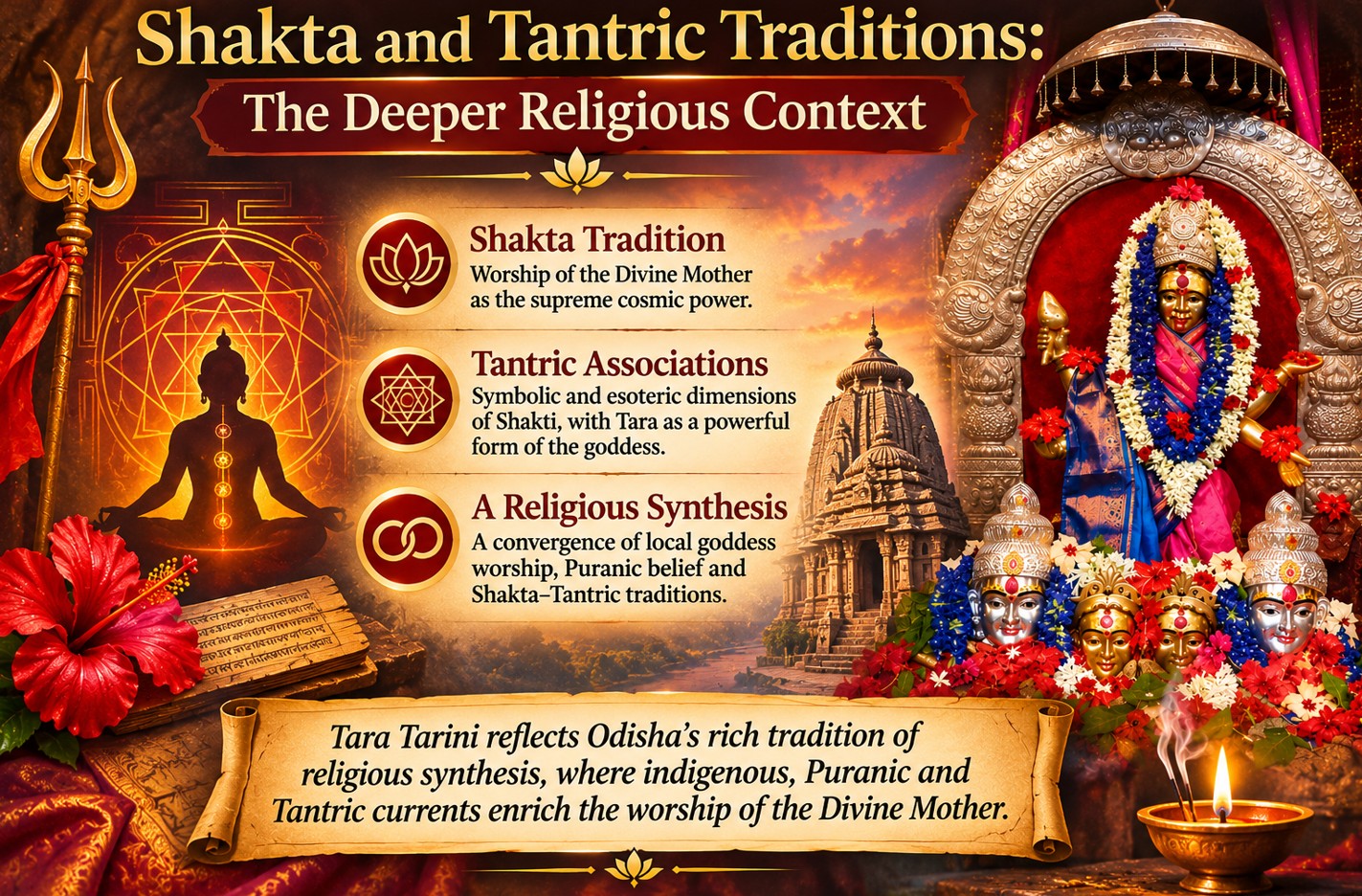
Tara Tarini's association with the wider Shakti Peetha tradition places it within this larger religious framework. The name Tara also carries particular significance in Tantric religious traditions, where Tara is recognised as a powerful manifestation of the Divine Mother associated with protection, wisdom and liberation.
Representational Image
It is important, however, to distinguish between the broader Tantric significance of Tara and the specific ritual practices historically followed at the Tara Tarini shrine. Similarity of names and theological associations does not, by itself, establish that every aspect of the temple's worship originated in a particular Tantric lineage.
A more useful interpretation is to view the temple as part of Odisha's wider history of religious synthesis, in which local goddess worship, Puranic mythology and Shakta theological traditions have interacted over time.
This layered character is precisely what makes Tara Tarini an important subject for historical and cultural study.
Historical Evolution: From Sacred Tradition to Institutional Heritage
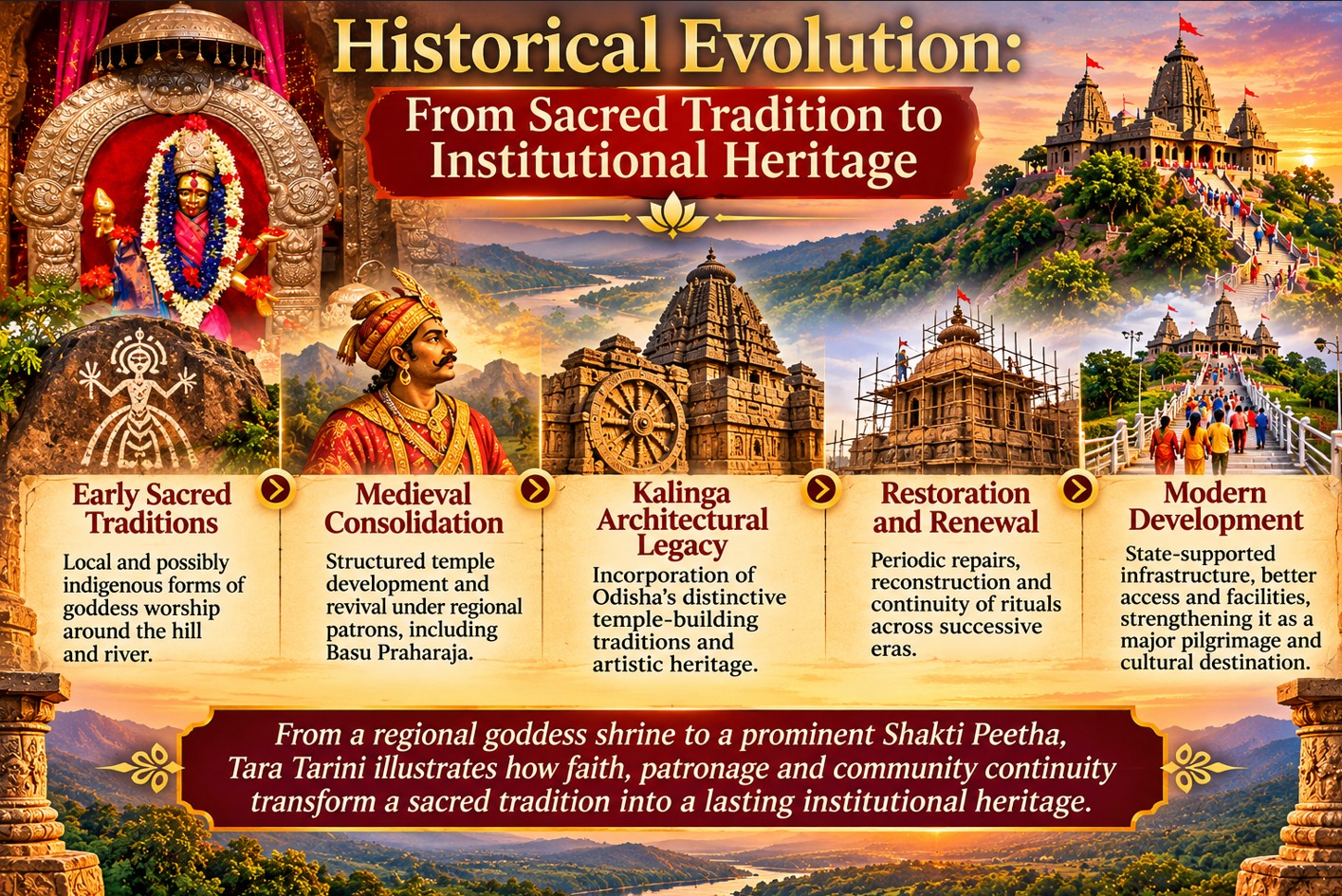
The historical development of Tara Tarini reflects the gradual transformation of a regional sacred centre into a major pilgrimage institution.
Accounts associated with the temple connect its development and revival with local patrons, including Basu Praharaja. Its history must also be understood against the broader background of Odisha's temple-building traditions, regional political patronage and the enduring importance of goddess worship.
Representational Image
The present architectural and institutional identity of the shrine represents successive phases of religious continuity and renewal rather than a history confined to one construction period.
Modern restoration, infrastructure development and improved pilgrimage facilities have further strengthened its position as one of Odisha's prominent religious destinations.
This evolution illustrates an important aspect of India's sacred institutions: religious continuity does not necessarily depend on the preservation of an unchanged physical structure. It often survives through the continuity of worship, collective memory, patronage and the ability of institutions to adapt to changing social conditions.
Chaitra Jatra: When Personal Faith Becomes Collective Identity
Among the most significant expressions of devotion at Tara Tarini is the annual Chaitra Jatra, celebrated during the Hindu month of Chaitra.
The festival attracts large numbers of devotees, particularly on Tuesdays, and is closely associated with the tradition of mundan, or the first tonsure ceremony of children. Families visit the shrine seeking the blessings of the twin goddesses, often marking important stages in the lives of their children through ritual offerings and prayers.

Representational Image
The significance of this practice extends beyond its religious meaning.
The first tonsure is a rite of passage, symbolising transition, renewal and the beginning of a new phase of life. When performed at a major pilgrimage centre, an intimate family ceremony becomes part of a much larger collective religious experience.
Chaitra Jatra thus brings together several dimensions of social life: family traditions, community participation, devotional exchange and regional belonging.
The festival also demonstrates how religious institutions maintain their relevance across generations. Mythological narratives acquire a living social presence when they are incorporated into recurring practices, family decisions and shared celebrations.
In this sense, Tara Tarini is not simply a place where people visit to worship. It is a place where religious identity is continuously reproduced through collective participation.
Sacred Ascent: The Spiritual Meaning of Pilgrimage
The physical journey to the hilltop shrine contributes another layer to the experience of devotion.
The ascent through the traditional steps or the modern access route is more than a geographical movement. For many devotees, the journey itself becomes part of the pilgrimage, symbolising a gradual transition from ordinary concerns towards spiritual reflection.

Representational Image
The elevated position of the temple reinforces this experience. As pilgrims move away from the river valley and approach the sacred summit, the landscape becomes an integral part of their encounter with the Divine Mother.
This relationship between physical movement and spiritual aspiration is a recurring feature of pilgrimage traditions across India. Sacred journeys frequently transform geographical distance into an expression of faith, discipline and personal commitment.
At Tara Tarini, the hill and the river together create an especially compelling setting for this experience.
Tara Tarini and the Cultural Identity of Southern Odisha
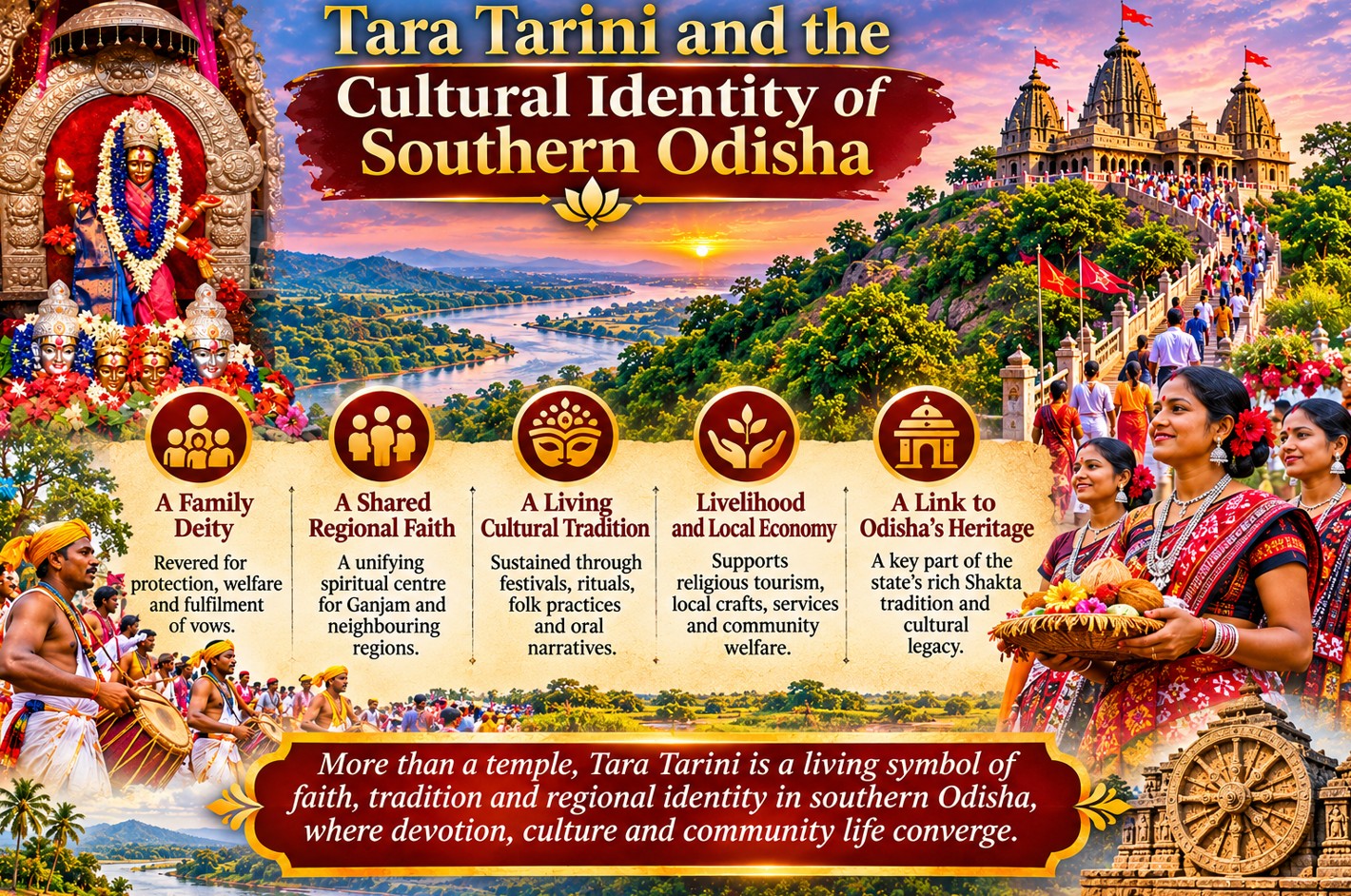
Beyond its theological and historical significance, the temple occupies an important position in the cultural imagination of Ganjam and neighbouring regions.
For generations, the twin goddesses have been associated with family welfare, protection, fulfilment of vows and the safeguarding of children. Their shrine has become a shared point of reference across communities, linking personal devotion with a wider sense of regional belonging.
Representational Image
Its importance also demonstrates how religious centres contribute to the construction of cultural identity. Through festivals, pilgrimage, oral narratives, ritual practices and collective memories, temples become institutions that preserve and transmit traditions.
Tara Tarini performs this role on multiple levels. It connects the religious heritage of Odisha with the wider Shakta tradition of India, while retaining a distinctive regional character shaped by the people, landscape and cultural practices of southern Odisha.
Its continued prominence also strengthens the relationship between religious tourism, local livelihoods and the public presentation of Odisha's cultural heritage.
However, preserving this significance requires more than improving physical infrastructure. The historical landscape, traditional practices, ecological environment and cultural knowledge associated with the shrine deserve equal attention.
Beyond Pilgrimage: A Living Heritage of Faith and Continuity
The enduring importance of Tara Tarini lies in its ability to bring together seemingly different dimensions of religious and cultural experience.
Its mythology speaks of divine motherhood and the sustaining power of Shakti. Its twin deities offer a distinctive expression of feminine divinity. Its hilltop location connects religious imagination with the natural landscape. Its ritual calendar transforms individual acts of devotion into collective cultural experiences.

Representational Image
Most importantly, the shrine demonstrates that sacred traditions are not static historical inheritances. They remain alive because communities continually reinterpret, practise and transmit them.
Tara Tarini should therefore be understood not merely as one of India's important Shakti Peethas, but as a significant cultural institution through which the spiritual history and regional identity of southern Odisha continue to find expression.
Overlooking the Rushikulya River from the heights of Kumari Hills, the shrine stands as a powerful reminder that India's sacred geography is also a geography of memory, identity and belonging. Its significance lies not only in the mythology of where Sati's body is believed to have fallen, but also in the generations of people who continue to find nourishment, protection and spiritual meaning in the presence of Maa Tara Tarini.