Move Slowly but Move Consistently, Says Nitin Vijay at Manav Rachna on Guiding Students to Success in a Hyper-Competitive World
Mumbai / Faridabad, Dec 23: Nitin Vijay, Founder & CEO of Motion Education, Kota, and one of India’s most respected Physics educators, visited Manav Rachna Educational Institutions, where he engaged with students on competitive examinations, mental well-being, and the evolving education ecosystem. Vijay’s Motion Education network spans over 80 centres across India, mentoring thousands of students each year. In the JEE Advanced 2025 examinations, the institute achieved a success rate of 65.8%, significantly above the national average, with many students securing top all-India ranks.
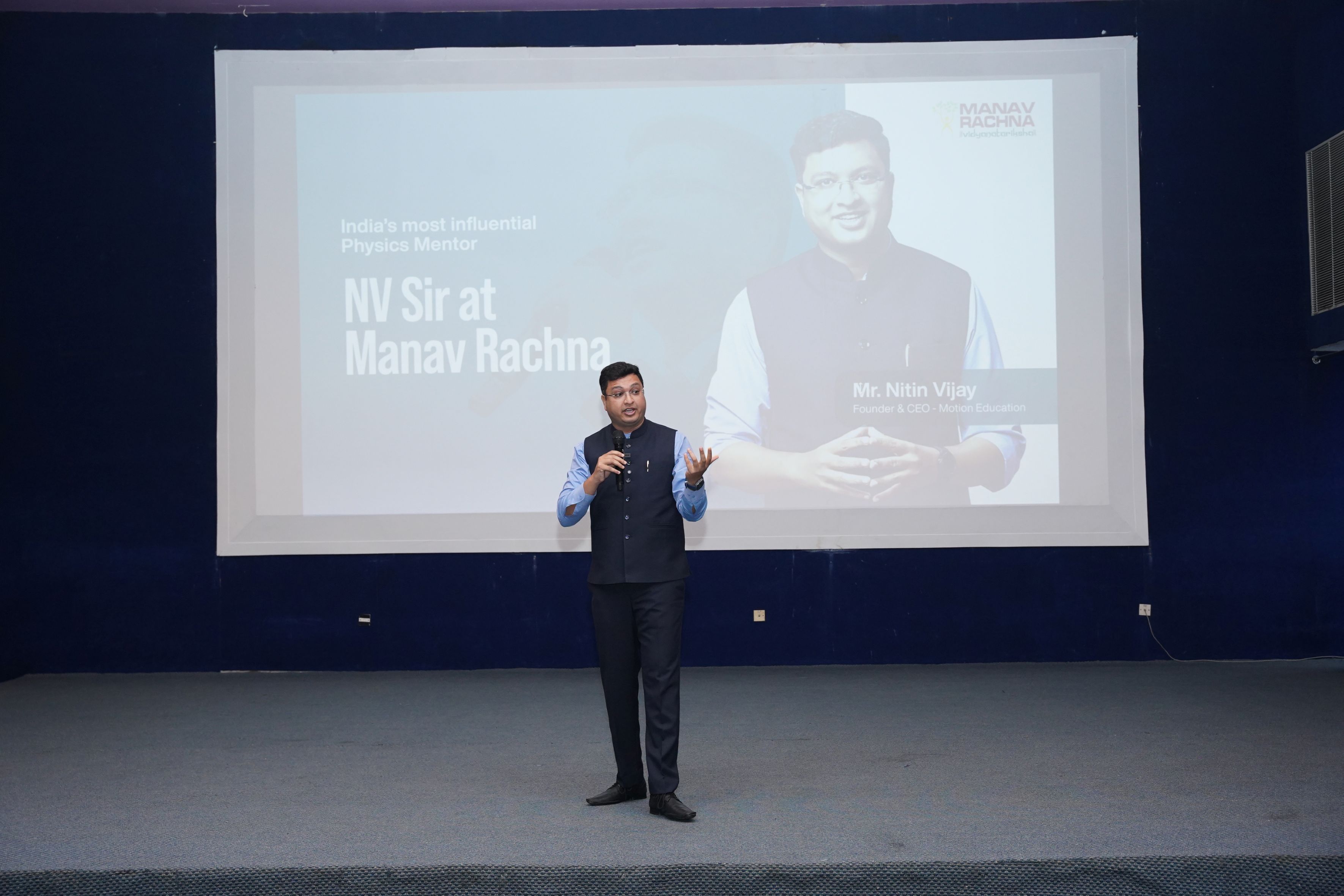
During his interaction with students, Vijay addressed the rising concerns around stress, burnout, and the pressure-filled culture surrounding competitive exams. He emphasized the importance of a shift from overwork to smart preparation, “The problem is not competition; the problem is the belief that pressure is the only path to success. The system needs to shift from overwork to smart work. Better timetables, regular assessments, clearly defined short-term goals, and making counselling an integral part of academics are essential. When preparation is guided in the right direction, excellence and mental well-being are not opposites, they complement each other.”
Vijay also reflected on how digital tools, AI, and social media are changing the learning landscape,
“AI and online content have made information widely accessible, but there is a clear difference between information and guidance. Today, the role of coaching is not limited to teaching concepts; it also involves helping students ask the right questions, analyse their mistakes, and develop discipline. Traditional coaching is evolving from a teacher-centric to a student-centric system, where technology acts as a support, not as a substitute. The success portrayed on social media is often an incomplete truth. Students must understand that comparison does not inspire, it creates stress. My advice is to compare your progress only with your own past self. Use the digital world as a tool for learning, not as a measure of self-worth.”
Building on Vijay’s views on smarter preparation and a student-focused education approach, Dr. Prashant Bhalla, President, Manav Rachna Educational Institutions, said,
“Competitive success cannot come at the cost of well-being. In an environment where achievement is often narrowly defined by ranks and results, education must consciously restore balance. As educators, our responsibility goes far beyond preparing students for examinations. National reforms like NEP 2020 set the direction, but it is institutions that must humanize learning. At Manav Rachna, our emphasis is on developing thinking minds, resilient individuals, and responsible citizens; these are outcomes that matter long after examinations are over.”
Vijay, the real-life inspiration behind the character of Jeetu Bhaiya in the popular Netflix series Kota Factory, also reflected on public perceptions of coaching hubs, “Kota Factory has accurately portrayed struggle, friendship, and pressure, but it also creates the impression that every student inevitably breaks down. The reality is that with the right guidance, strong support systems, and balance, cities like Kota also teach confidence and discipline. Here, the preparation is not just for ranks, it is preparation for life.”
Dr. Amit Bhalla, Vice President, Manav Rachna Educational Institutions, added,
“In today’s digital and hyper-competitive environment, students encounter constant comparison and pressure. Guidance from experienced educators, combined with structured learning and peer support, enables them to stay focused, build resilience, and make informed choices about their future.
Vijay also addressed the importance of trust and transparency in India’s examination system,
“An examination is not just a selection process; it is the foundation of trust in a nation’s talent. There can be no compromise on this. Trust in the examination system will return only when both transparency and accountability are ensured. From paper setting to evaluation, better use of technology, strict penalties for lapses, and independent oversight mechanisms are absolutely necessary.”
Concluding his session, he shared a message of patience and perseverance for students navigating a hyper-competitive, always-online world,
“I would simply say this to students: move slowly but move consistently. In this hyper-competitive, always-online world, patience is the greatest strength. Trust yourself, trust the system, and remember, success is not a single exam, it is a journey.”
No Responses