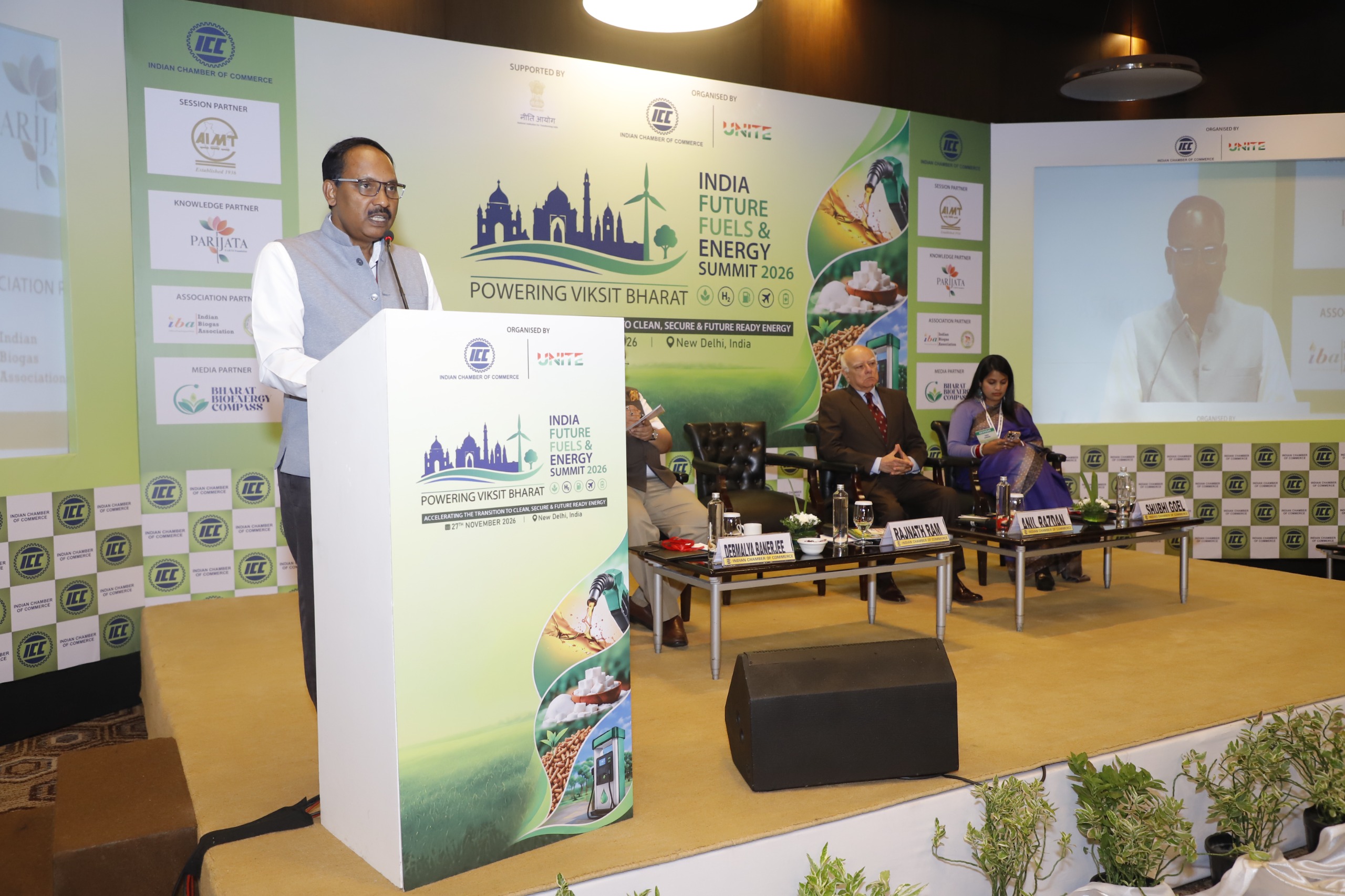
New Delhi, November 28, 2026: India's primary energy consumption is expected to rise 2 to 2.5 times and its electricity demand around 4 to 5 times as the country works towards developed nation status by 2047, Mr. Rajnath Ram, Adviser (Energy), NITI Aayog, said today, adding that the real challenge is to enhance energy security while keeping energy affordable and sustainable. He was speaking at the India Future Fuels & Energy Summit 2026, organised by the Indian Chamber of Commerce (ICC) on the theme "Accelerating The Transition To Clean, Secure & Future-Ready Energy".
"Energy security is no longer only about price and availability. It is also about choke points, shipping routes and supplier concentration, and every country is now treating energy as a strategic asset," Mr. Ram said.
He said energy security now carries more weight than climate goals in view of the changing geopolitical situation. The 2026 West Asia crisis disrupted shipping and hit oil and energy supplies, while Brent crude rose from about USD 71 a barrel to USD 117 in April this year and is still hovering around USD 96. India managed the crisis through an inter-ministerial committee and daily monitoring, and its prices rose by nearly 8 to 10% against around 50% in other parts of the world. The government is now seriously considering building at least 40 million tonnes of strategic crude oil storage.
Mr. Ram cautioned that the transition is creating new dependencies. India has almost 170 GW of solar capacity but very little ingot and wafer manufacturing, and imports about 95% of its magnets and 90% of its battery cells. He said China has recently decided to restrict exports of certain solar technologies, and India has to build its own manufacturing capacity. "The challenge is not only about securing barrels and cargoes. It is equally about securing wafers, cells, magnets, minerals and the materials that support the grid," he said.
Mr. Ravi Prakash Agrawal, Mission Director, NTPC Ltd., said coal is sufficiently available in the country for the next 100 to 150 years and costs much less than oil and gas. "Business always comes down to economics. Using green fuel to replace oil and gas is much better than burning it in coal plants, because co-firing raises the cost of power, and that affects every individual in the country," he said. Around 12 power plants in the NCR are co-firing biomass, with more being added. Co-firing reached almost 4.67% last year and will cross the mandatory level of 5% this year. Co-firing of around 10% is possible with non-torrefied biomass and up to 20% with torrefied biomass, which can cost up to double, making cost-reducing technology the key enabler.
Mr. Anil Razdan, Chairman, ICC National Expert Committee on Energy, called on Indian industry to invest across the full technology chain, from raw material extraction to processing and trade. "We have to be world leaders, not buyers of technology but owners and inventors of technology. Expenditure on research and development, by the government, the country and industry alike, must rise from under 1% to over 5% if we really want to be there on the global scene," he said. He noted that control over fossil fuels has been the cause of most 21st century wars, that carbon footprints are now creating trade barriers, and that investors need assured returns and timely power evacuation to keep projects viable.
Mr. Debmalya Banerjee, Regional Director, ICC North, said India must genuinely move to green energy sources across the value chain, noting that electric vehicles still draw their charging power from thermal plants. "Nuclear energy, used in the appropriate manner, can solve our energy problems to a great extent. Hydrogen has not picked up well in the country, and European countries are far ahead of us in this technology," he said, adding that ICC will hold its green energy summit in February.
The India Future Fuels & Energy Summit 2026 brought together voices from government, the power sector and industry to deliberate on India's future energy needs and future fuels. The discussions covered energy security, domestic clean energy manufacturing, biomass co-firing, research and development, nuclear energy and hydrogen. ICC thanked its sponsors, partners and industry associations for supporting the summit, and called on industry to step up investment in research, technology and domestic manufacturing to build a secure and future-ready energy system.