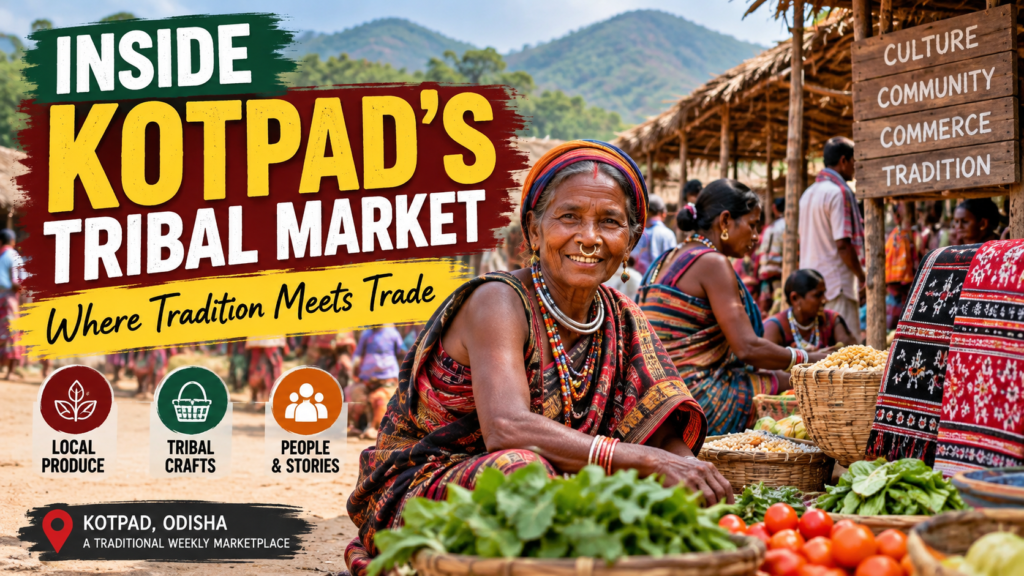
In southern Odisha, the traditional weekly market at Kotpad is more than a place to buy and sell goods. It is a living social space where tribal communities, farmers, artisans and local traders come together, keeping an old rhythm of rural commerce alive.
A Market With a Living Cultural Identity
On market day, Kotpad takes on a distinctly different character. The town in Odisha’s Koraput district becomes a meeting point for people arriving from surrounding villages with agricultural produce, forest products, household goods, textiles and traditional crafts. The marketplace is not simply a commercial destination; it is part of the social fabric of the region.
Unlike modern shopping centres, where transactions are often quick and anonymous, a traditional haat such as Kotpad’s operates as a community gathering. People meet friends and relatives, exchange news, discuss prices, purchase necessities and maintain relationships that extend well beyond the marketplace.
The Weekly Haat Tradition
Weekly haats have historically played an important role in the rural economy of Odisha. For communities living in villages and forested areas, the market provides a regular opportunity to bring surplus produce to buyers and obtain items that may not be available locally.
Kotpad’s weekly market follows this traditional rhythm. Market day brings together sellers and buyers from different communities, creating an atmosphere that is part marketplace, part social gathering and part cultural showcase.
The significance of such markets lies in their simplicity. Goods are displayed openly, bargaining is common, and personal relationships remain an important part of commerce.
From Farm and Forest to Market
One of the most striking aspects of a traditional tribal market is the diversity of products. Fresh vegetables, fruits, grains, roots, spices and other agricultural products form an important part of the marketplace.
Forest-based products also reflect the close relationship between local communities and their natural surroundings. Depending on the season, markets in the tribal belt of Odisha can feature forest produce, medicinal plants, roots, leaves and other naturally sourced products.
For producers, bringing these goods to the weekly market provides an important source of cash income. For consumers, the haat offers access to locally grown products that are closely connected to the region’s agricultural and ecological landscape.
A Marketplace of Traditional Crafts
Kotpad is particularly significant because its cultural identity is closely connected with traditional handloom weaving. The famous Kotpad textile is known for its natural-dyeing tradition and distinctive earthy shades.
The textile tradition has historically been associated with the Mirgan weaving community and with the tribal communities of the surrounding region. Natural dyes, traditional motifs and handloom techniques have helped give Kotpad fabrics a character that is distinctly different from mass-produced textiles.
Kotpad handloom received a Geographical Indication tag in 2005, becoming the first product from Odisha to receive GI recognition. The recognition helped draw wider attention to a craft that had traditionally remained rooted in the region.
Commerce With a Human Face
The importance of Kotpad’s market cannot be measured only by the volume of goods exchanged. Its deeper value lies in the human interactions that take place there.
For many sellers, the weekly market is an opportunity to interact directly with customers. Producers can bring what they have grown, collected or made and negotiate directly with buyers. This creates a form of local commerce that is very different from supply chains dominated by distant intermediaries.
At the same time, the market provides customers with an opportunity to understand where products come from and who produces them. A basket of vegetables, a handwoven textile or a traditional ornament can carry a story about a community, a craft and a landscape.
A Social Space Beyond Buying and Selling
Traditional markets have always had a social dimension, and Kotpad is no exception. People do not necessarily visit the weekly haat only to shop.
Market day can become an occasion to meet relatives, reconnect with acquaintances and exchange information. In many rural communities, such gatherings have historically helped strengthen social networks and community relationships.
This social character is one reason weekly haats remain relevant even as modern retail expands. A supermarket can provide convenience, but it cannot easily replicate the social atmosphere of a traditional community market.
The Sounds and Colours of Kotpad
The visual character of a traditional market is part of its appeal. Baskets filled with vegetables, colourful textiles, traditional ornaments, handmade goods and everyday household products create a constantly changing scene.
The sounds are equally distinctive: conversations between sellers and customers, bargaining over prices, greetings between people who know each other and the movement of traders preparing their stalls.
For visitors, the experience can feel like stepping into a different rhythm of commerce—one that is slower, more personal and closely connected with everyday village life.
Preserving a Traditional Economy
Markets such as Kotpad also raise important questions about the future of traditional rural economies. Modern retail, changing consumer preferences, improved transportation and digital commerce are transforming the way people buy and sell goods.
Yet the weekly haat continues to offer something that modern retail cannot easily replace: direct participation in a local economy.
The challenge is to ensure that traditional markets evolve without losing the community relationships and cultural practices that make them distinctive. Better infrastructure, fair prices, improved market access and greater recognition for local producers can help strengthen these traditional economic systems.
Why Kotpad Matters to Odisha’s Cultural Landscape
Kotpad represents a broader story about Odisha’s tribal belt. The state’s cultural heritage is not confined to monuments, museums or festivals. It can also be found in ordinary places where people continue to live, work and trade according to long-established traditions.
The weekly market is therefore a kind of living cultural institution. Its importance comes precisely from the fact that it remains part of everyday life.
Here, heritage is not displayed behind glass. It is carried by farmers bringing produce to market, artisans making traditional products, weavers preserving techniques and families passing knowledge from one generation to another.
A Window Into Responsible Cultural Tourism
For travellers interested in experiencing Odisha beyond conventional tourist destinations, Kotpad offers a valuable perspective. A visit to a traditional market can provide a more grounded understanding of local life than simply visiting a landmark.
But such visits also require sensitivity. Tribal communities should not be treated as attractions. Photography should be undertaken respectfully and, where appropriate, only with permission. Visitors should also support local producers by purchasing authentic goods at fair prices rather than treating the market merely as a photo opportunity.
Responsible tourism can turn a market visit into a meaningful exchange—one in which visitors learn about local traditions while contributing to the livelihoods of the people who sustain them.
Keeping the Haat Alive
The future of Kotpad’s traditional market will ultimately depend on whether it continues to serve the needs of the communities around it. Its survival should not depend solely on tourism.
The strongest traditional markets are those that remain economically useful to local people while adapting carefully to changing circumstances. Better facilities, access to information, improved transportation and fair opportunities for artisans and farmers can strengthen the market without erasing its traditional character.
Kotpad’s weekly haat reminds us that markets are not always just about money. They can be places where communities preserve relationships, knowledge and identity.
More Than a Market
In an increasingly digital economy, the traditional weekly marketplace may appear to belong to another era. But Kotpad tells a different story.
Here, commerce remains personal. Agricultural produce travels from village fields to market stalls. Traditional crafts connect generations. Handloom traditions continue to carry the identity of a place. And people still gather not only to buy and sell, but to meet, communicate and participate in community life.
That is what makes Kotpad’s tribal market worth documenting and experiencing. It is not simply a weekly marketplace in southern Odisha. It is a living expression of the region’s culture—where tradition, community and commerce continue to meet.